Give AI-assisted work an operating system.
Jacobra Signal OS turns raw founder intent into scoped projects, reusable context, governed workflows, inspectable runs, and reviewable outputs.
Venture thesis · Product architecture · Workflow model · Governance
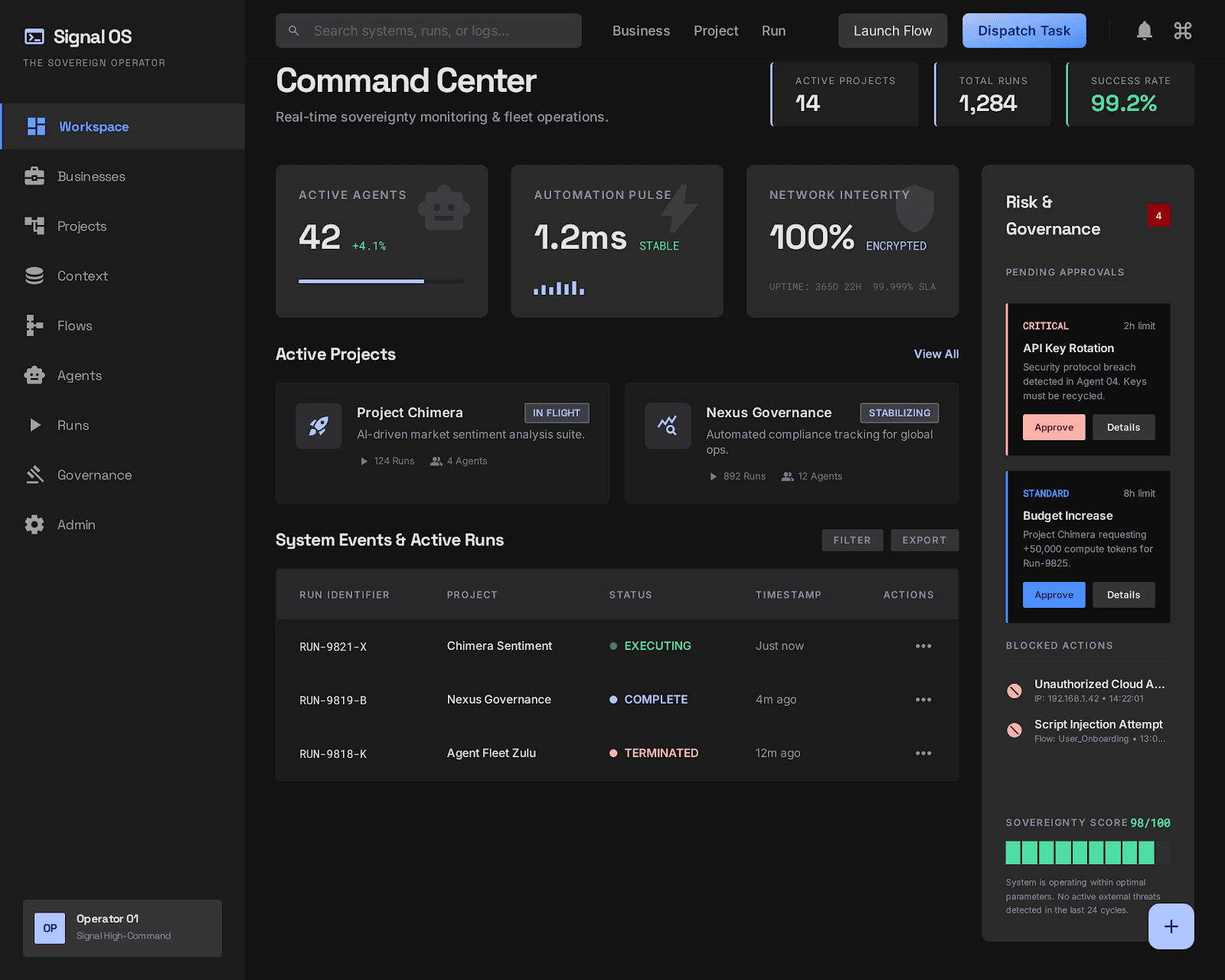
Agent tools create output, but teams still lose scope, memory, provenance, and control across repeated work.
Organize AI-assisted execution around businesses, projects, governed context, workflows, and review, not around a bot list.
A local prototype with operating records, governed dispatch, recurring runs, review states, and execution-plane sync.
Working internal prototype plus documented architecture. Interface-study values are illustrative, not customer metrics.
The agent is not the operating model.
Most agent interfaces begin with the agent: choose a model, write a prompt, and hope the work can be reconstructed later. Real operating work begins somewhere else, with a business, a project, an objective, trusted context, and a clear threshold for human review.
Jacobra asks a more practical question: how can a small team use AI repeatedly while preserving scope, memory, visibility, and authority?
One chain from intent to governed output.
Every run belongs somewhere, uses explicit context, follows a workflow, and ends in an inspectable output or approval state.
- 01
Workspace
- 02
Business
- 03
Project
- 04
Context
- 05
Flow
- 06
Agent policy
- 07
Run
- 08
Output
- 09
Governance
Project is the operating container
People think in clients, campaigns, products, and initiatives. The project holds the goal, context, flow, agents, runs, and outputs together.
Context is durable infrastructure
Reviewed information becomes reusable memory with scope, trust, freshness, and provenance instead of disappearing into one enormous prompt.
Agents are governed roles
An agent has an assignment, allowed tools, approval rules, and project boundaries, not unlimited permission disguised as autonomy.
Runs must remain inspectable
Every execution should expose what context was used, what happened, what evidence supported it, and which output can be reviewed or promoted.
Interface studies for an inspectable operating system.
These are genuine design artifacts from the product workspace. They demonstrate hierarchy and interaction intent; all names, counts, success rates, and run values shown inside them are illustrative.
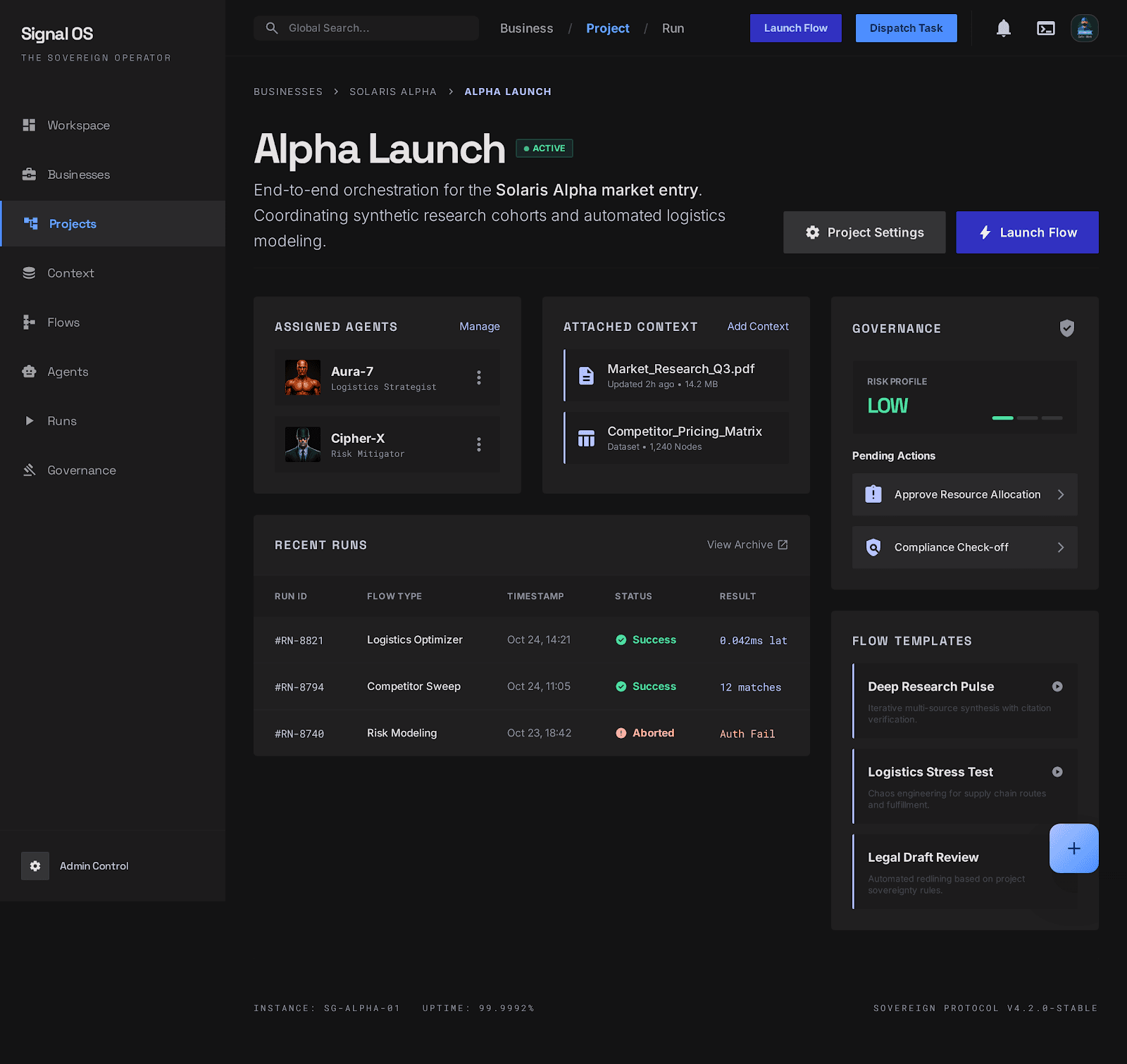
Project operating view
interface studyInterface study connecting project context, agents, governance, flows, and recent runs. Displayed values are illustrative.
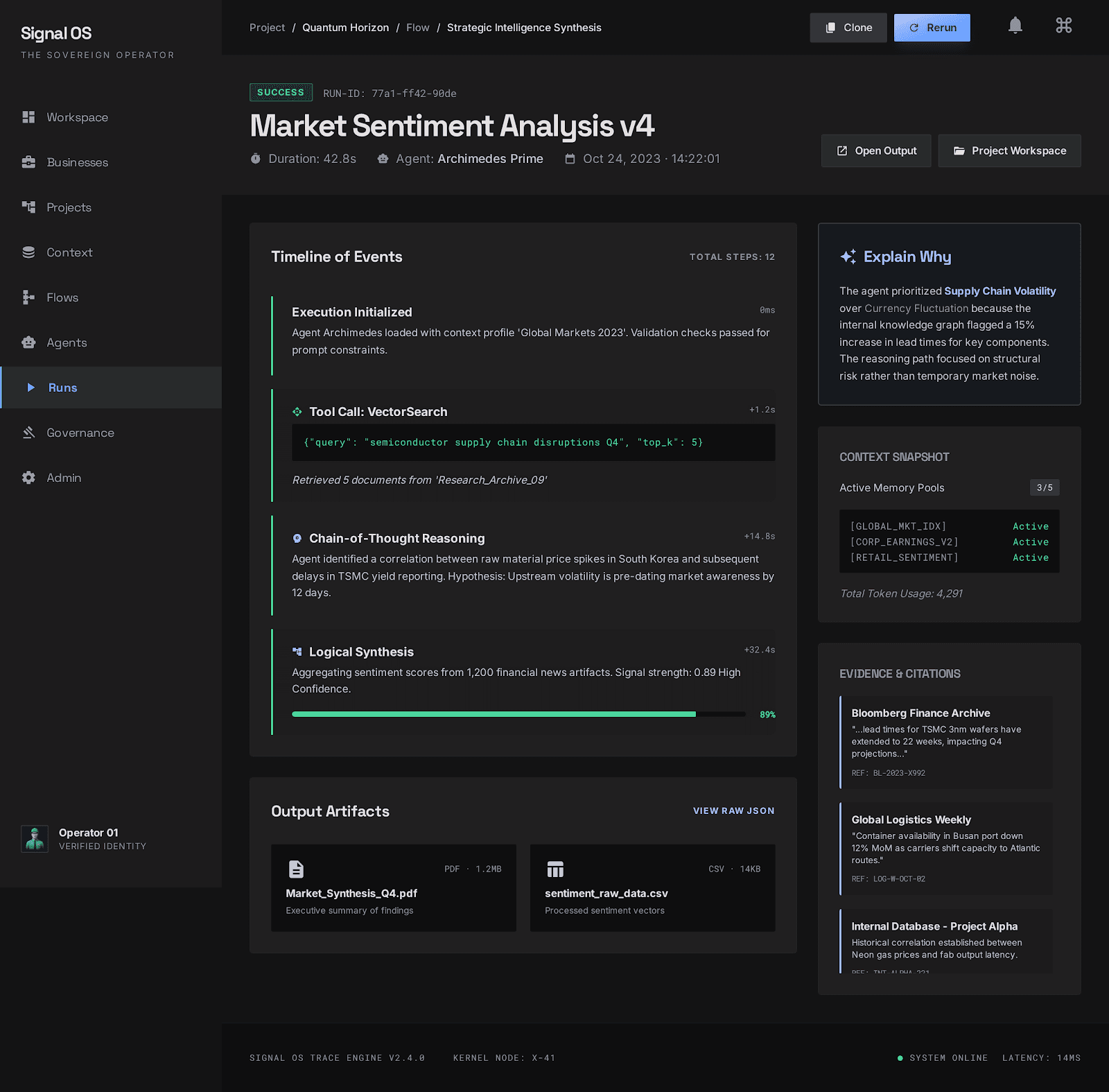
Run trace
interface studyInterface study for execution trace, evidence, context, and output artifacts. Displayed values are illustrative.
A real prototype, with an explicit boundary.
Jacobra is not presented as a public SaaS or a customer-proven platform. The evidence is the implemented local system, its persisted domain model, and its documented governed execution path.
The prototype persists business, project, context, flow, output, review, and governance records locally.
Source · Jacobra Signal OS repository audit
A governed vertical slice classifies signals, dispatches work into the execution plane, syncs runtime state, and proposes reviewed memory writeback.
Source · Signal OS / execution-plane contract
Enough system to test the thesis honestly.
Persistent business and project records
Scoped context and memory records
Flow instances and call specifications
Governed dispatch into an execution plane
Recurring runs and stale-run escalation
Output, review, and writeback proposals
Marketing integration policy scaffolding
Explicit prototype security and multi-user limits
Shape the product around how work survives.
The work connects venture thesis, information architecture, domain modeling, workflow design, agent governance, product language, interface direction, and implementation boundaries. The goal is not to make autonomy look magical. It is to make assisted execution useful, reviewable, and repeatable.